Slot Car Corner  
Enhanced Controller Hookup Panels  

Copyright (c) 2004, 2005, 2006 by Steve Sawtelle - All Rights Reserved.

 
Copyright (c) 2006 by Slot Car Corner L.L.C. - All Rights Reserved.  


Introduction

Since writing the “Making Controller Hookup Panels” article published online in Slot Car Illustrated recently, several readers have emailed me asking about various enhancements to the basic design.  In particular, a switch to reverse lane direction and substituting a circuit breaker for the fuse holder seem to be popular requests.  By adding a switch to control lane direction, you essentially have two tracks in one.  If you’ve never run your layout in the opposite direction, it can be very challenging and a lot of fun.  A circuit breaker is generally more convenient to reset than replacing a fuse and there is no cost associated with purchasing replacement fuses.

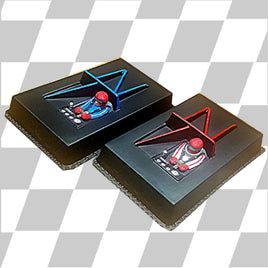
For those who read the original article, you’ll note some of the material is repeated here.  I had originally intended to write a short addendum to the original article; however, it was very confusing trying to direct the reader to one article for some steps and the addendum for others.  Therefore I opted instead to write a complete article which describes the entire process of building the enhanced controller hookup panel.  The accompanying picture shows the enhanced controller hookup panel including a toggle switch to reverse lane direction and a manual resetting circuit breaker in lieu of the fuse holder in the original design (you can still use the fuse holder if you prefer).

    Click on thumbnail to see larger image; use browser "Back" button to return.

Step-by-step instructions with accompanying illustrations describing how to make these panels are provided below.  Other types of connectors can be used as well; however, the basic construction steps and wiring will remain the same.


Materials Needed

To build a controller hookup panel like the one shown earlier, you’ll need the following materials:

Note:   If you are having difficulty locating any of the items shown or mentioned in this article, you can purchase them directly from me (see the "Online Store" link on this website).  I also offer a variety of pre-packaged kits with everything needed to assemble these panels.  Preassembled panels, ready for installation, and other track wiring items (e.g. heavy duty terminal blocks, easy-to-use wiring templates) are also available.

1)                  Carlson 1 ¼” electrical box (technically this is referred to as an “LB”) as shown in the picture (only the cover will be used).

    Click on thumbnail to see larger image; use browser "Back" button to return.

Note:         The panels shown are very sturdy and can easily be mounted on horizontal or vertical surfaces.  However, other panels, covers, plates or boxes can be substituted based on your needs/tastes. 

2)                  A panel mount thermal circuit breaker such as the one shown below.

Warning:   Be careful to size the rated capacity of the circuit breaker properly being especially careful not oversize it!  The one shown is rated at 3 amps (I would not recommend going any higher for a home layout); however, it may take a couple of seconds to trip with a power supply rated at 3 amps.  To reduce the time required to trip the circuit breaker, your power supply should be rated (continuous amps) at least 3 times higher than the circuit breaker you plan to use.  This will help ensure when a short circuit occurs, the power supply will supply full rated current (and possibly higher for a short period of time) which will reduce the time required to trip the thermal breaker.  This is because more heat is generated as the amperage increases which causes the thermal circuit breaker to trip quicker.  If your power supply does not provide sufficient amps (10 amps continuous for the circuit breaker used here), stick with a panel mounted fuse holder instead.

    Click on thumbnail to see larger image; use browser "Back" button to return.

3)                  A heavy duty DPDT (double pole, double throw) panel mount toggle switch rated for DC use.  Make sure the toggle switch is the “ON-ON” variety and has ¼” male blades (I’ll discuss this in more detail further in the article).  The toggle switch shown in the accompanying picture is rated at 15A for 12 volts DC.

    Click on thumbnail to see larger image; use browser "Back" button to return.

Refer to the picture for items 4 – 8 (shown top to bottom).

    Click on thumbnail to see larger image; use browser "Back" button to return.

4)                  #8-32 x 1 1/2” brass screws (3 per panel) for the “posts” the controller alligator clips will be attached to.

5)                  Insulated or uninsulated ring terminals (3 per panel) designed for 14 – 16 gauge wire.  Uninsulated ring terminals are shown in the pictures accompanying this article.

6)                  #8-32 brass nuts (3 per panel).

7)                  Plastic fender washers (3 per panel – 3/16” I.D., 7/8” O.D.); 1 each in the following colors - black, white and red.

8)                  #8-32 stainless steel locknuts with nylon insert (3 per panel).

Other materials which will be needed:

9)                  14 gauge wire (5 lengths per panel; minimum recommended length is 24” – adjust to your specific requirements as necessary); 1 each black and white; 3 each red.

10)              14 gauge wire (2 lengths per panel; 4” long; 1 each black and red)

11)              14 gauge wire (2 lengths per panel; 8” long; 1 each black and white)

12)              3/16” (i.d.) x 7/8” (o.d.) metal fender washers (3 per panel)

13)              Insulated female push-on terminals ¼” wide designed for 14 gauge wire – 4 per panel (shown on left in picture).

14)              Insulated female push-on terminals ¼” wide designed for 12 gauge wire – 2 per panel (shown on right in picture).

    Click on thumbnail to see larger image; use browser "Back" button to return.

Optional

15)              Spray paint in desired colors (typically corresponding to the lane colors associated with your layout) which adheres to plastic.  Tamiya paint for plastics or Krylon Fusion are two examples.

16)              Spade terminals (5 per panel) for attaching wires from the controller hookup panel to a terminal block.  Make sure the spade terminals are designed for 14-16 gauge wire and fit the terminal blocks you plan to use.  If you do not use terminal blocks to make your electrical connections, you will not need this item.

17)              5 position (minimum – strips with additional terminals can also be used) terminal barrier strip (or “terminal block”) for connecting controller hookup panel wiring to track wiring (see picture).

     Click on thumbnail to see larger image; use browser "Back" button to return.


Tools Needed

The following tools will be required when building a controller hookup panel.

Refer to the accompanying picture for items 1 - 6 (shown left to right across the top row).

    Click on thumbnail to see larger image; use browser "Back" button to return.

1)                  Safety glasses – they only protect you when you’re wearing them (enough said…).

2)                  Rosin flux (do NOT use acid flux which is commonly used in plumbing applications).

3)                  Rosin core solder (do NOT use acid core solder which is commonly used in plumbing applications).

4)                  Lighter fluid

5)                  Wire stripper

6)                  Wire crimper

Refer to the previous picture for items 7 - 11 (shown left to right across the bottom row).

7)                  Drill bits (sharp!)

a)      11/64” (for #8 brass screws)

b)      Bit for the hole to mount the circuit breaker – check the packaging to determine what size drill bit is required.  If the packaging does not indicate what size drill bit to use, a drill gauge (item 11 below) can be used to determine the correct size.

c)      Bit for the hole to mount the DPDT toggle switch - check the packaging to determine what size drill bit is required.  If the packaging does not indicate what size drill bit to use, a drill gauge (item 11 below) can be used to determine the correct size.

8)                  5/16” deep socket and ratchet

9)                  Sandpaper – course (40-80), medium (100 – 150), fine (200 – 400), very fine (600)

10)              Q-tips

11)              Drill gauge

Other tools which will be needed:

12)              Drill press

13)              3/8” drill (cordless or corded)

14)              Soldering iron (recommended 40W minimum) or soldering station

15)              Soldering helper (holds wire, components with small clips freeing up your hands – see picture)

     Click on thumbnail to see larger image; use browser "Back" button to return.

16)              Jigsaw or hole saw

17)              Dark marker (or soft pencil)

18)              Scissors or Xacto Knife

19)              Hacksaw or Dremel tool with cutoff disk

20)              Small piece of cardboard

21)              Small pair of needle nose pliers

22)              Small pair of ChannelLock pliers


Step-by-Step Instructions

Now that you’ve assembled the materials and tools needed, follow the instructions below to build the controller hookup panel.

Prepare Mounting Panel

1)                  Remove the cover from the electrical box as shown in the photo.  The cover will be used to mount the fuse holder and brass posts.  The screws and box enclosure will not be needed for this project.

    Click on thumbnail to see larger image; use browser "Back" button to return.

2)                  The underside of the cover or “panel” (see picture) has a weatherproof gasket and flanges along each side to make a tight seal when fastened to the box enclosure.

    Click on thumbnail to see larger image; use browser "Back" button to return.

3)                  If you rest the panel on a flat surface, the panel will not wobble; however, there is a small gap between the table surface and the underside of the panel.  You can either use the panel like this or remove the gasket material and flanges so the panel will lay flush on your mounting surface with no gaps.  If you decide to go this route, a Dremel tool or hacksaw can be used to remove the flanges (see picture).

    Click on thumbnail to see larger image; use browser "Back" button to return.

Don’t worry if the underside of the panel gets cut up or scratched while removing the flanges.  Once mounted, no one will ever see the underside of the panel.  If you decide to remove the gasket and flanges, the panel will look something like the one in the picture.

    Click on thumbnail to see larger image; use browser "Back" button to return.

4)                  Before proceeding, take a thin piece of cardboard and trace the outline of the panel as shown (see picture).  Put the cardboard in a safe place – it will be used to make a mounting template for the panel in a later step.

    Click on thumbnail to see larger image; use browser "Back" button to return.

5)                  Using the DPDT toggle switch, circuit breaker (or fuse holder if you prefer) and plastic fender washers, layout your panel.  For the panel shown in this write-up, components will be mounted from left to right as follows:  1) toggle switch controlling lane direction, 2) circuit breaker, and 3) the three washers for the brass posts to the right.  Make sure to leave sufficient spacing between components so they do not interfere with one another (including wires which will eventually be attached to each component under the panel).  You should also ensure none of the components which will eventually be mounted under the panel are mounted within ¼” of the outside edge of the panel (this border or “lip” will be needed when mounting the panel to your table/layout).  The picture shows how the components will be arranged.  Note the orientation of the toggle switch – in this position, the toggle will “point” in the direction cars are actually running around the layout.

    Click on thumbnail to see larger image; use browser "Back" button to return.

6)                  Layout and mark the centers of the toggle switch, circuit breaker and three plastic fender washers on the panel as shown (see picture).  For this panel with these components, hole centers measured from the left edge of the panel are 7/8” (toggle switch), 2” (circuit breaker), 3 1/8” (brass post for “black” washer), 4 3/8” (brass post for “white” washer) and 5 5/8” (brass post for “red” washer).  The marks will be used to drill mounting holes in the next step.

    Click on thumbnail to see larger image; use browser "Back" button to return.

Warning:  Take appropriate safety precautions when drilling the plastic covers.  Safety glasses should be worn at all times and drill bits must be sharp.  A drill press will make this step much easier and safer – a handheld drill is NOT recommended.  Make sure to secure the panel to your drill press table BEFORE drilling – drill bits sometimes have a tendency to “grab” the panel and spin it dangerously at very high speed.

7)                  Drill holes in the panel using the layout marks as a guide.  A drill press with a jig such as the one shown in the picture will help ensure all holes are centered and help prevent the panel from spinning if the drill bit should “grab” it.  Note the screws in the holes at both ends of the panel used to temporarily secure the panel to the jig while drilling.

    Click on thumbnail to see larger image; use browser "Back" button to return.

Tip:            Most panels will require multiple hole sizes.  Setup your drill press for a given hole/bit size and then drill ALL panels (one at a time…) in production line fashion.  Once all holes for a given size have been drilled, move on to the next hole/bit size and drill ALL panels.  Continue in this fashion until all holes have been drilled.

Once all holes have been drilled, your panel should look something like this.

    Click on thumbnail to see larger image; use browser "Back" button to return.

8)                  If you plan to paint the panels, you will probably want to sand the pebble grain and/or raised letters to provide a smoother finish.  Start with course sandpaper (50-80 grit) and sand off any grain and/or raised letters (as shown below).  Use successively finer (higher number) sandpaper finishing with a 600 or 800 grit.  Brush off as must sanding dust as possible and then use a tack cloth to remove any fine dust which still remains.  Finally, use a rag dipped in some alcohol (you don’t need much) to finish cleaning the panel surface.

    Click on thumbnail to see larger image; use browser "Back" button to return.

Caution:    Using a belt sander or palm sander is not recommended for this step – they are generally too aggressive and will likely damage or distort the relatively “soft” plastic panel.

9)                  Paint each panel using paint designed for plastic.  Apply several light coats of paint, in accordance with the paint manufacturer’s directions, to prevent “running”.  The panel in the picture has just received a final coat of paint before being set aside to dry thoroughly before mounting the panel components.

    Click on thumbnail to see larger image; use browser "Back" button to return.


Component Preparation

Now that the panel has been drilled and painted, it’s time to prepare the various components which will be mounted to the panel.  Here’s how:

1)                  If you plan to use terminal blocks to facilitate your wiring connections, start by attaching a spade connector to one end of each “long” wire (1 black, 1 white, 3 red).  For each wire, follow these steps.

a)      Strip off about 5/16” of insulation as shown in the picture.

    Click on thumbnail to see larger image; use browser "Back" button to return.

b)      Carefully twist the strands of wire between your fingers to make sure they are “tight”.  Then place a small dab of rosin soldering flux on the bare wire as shown (see picture). 

    Click on thumbnail to see larger image; use browser "Back" button to return.

c)        Place a spade connector over the bare wire and use a wire crimp tool to fasten (“crimp”) securely as shown (see picture).

    Click on thumbnail to see larger image; use browser "Back" button to return.

d)      Solder the spade connector to the wire as shown (see picture).

    Click on thumbnail to see larger image; use browser "Back" button to return.

2)                  Attach a ring terminal to one end of the black (8”), white (8”) and one (1) of the “long” red wires.  For each wire, follow these steps.

a)      Strip off about 5/16” of insulation (refer to the picture in step 1a)

b)      Carefully twist the strands of wire between your fingers to make sure they are “tight”.  Then place a small dab of rosin soldering flux on the bare wire (refer to the picture in step 1b).

c)      Place a ring terminal over the bare wire and use a wire crimp tool to fasten (“crimp”) securely as shown (see picture).  Do NOT solder the ring terminal just yet.

    Click on thumbnail to see larger image; use browser "Back" button to return.

d)      At this point, the 8” white, 8” black and one (1) “long” red wire should each have a ring terminal crimped to one end.  Do NOT solder the ring terminals just yet.

3)                  The following steps describe how to make the brass posts.  You’ll need to repeat these steps for each of the three (3) posts.  For each of the three (3) wires you fastened a ring terminal to earlier (one black 8”, one white 8” and one “long” red), follow these steps:

a)      Slip the ring terminal over a #8 brass screw which will serve as a post.  Thread a brass nut onto the post until it is about 3/8” from the head of the screw as shown (see picture).  Note the orientation of the ring terminal – be sure the ring terminal is oriented as shown (this will make it easier to mount the post to the underside of the panel in a later step).

    Click on thumbnail to see larger image; use browser "Back" button to return.

b)      Take a small brush and spread soldering flux under the head of the brass screw/post and around the terminal connector as shown.

    Click on thumbnail to see larger image; use browser "Back" button to return.

c)      Thread the brass nut the remainder of the way onto the brass screw until just barely finger tight – do not over tighten!  The brass post with a ring terminal and wire attached is now ready for soldering (see picture).

    Click on thumbnail to see larger image; use browser "Back" button to return.

d)      Use a soldering helper as shown to hold the brass post.  This will free up both hands for soldering.

    Click on thumbnail to see larger image; use browser "Back" button to return.

e)      Place the tip of your soldering iron under the ring terminal as shown.  The tip should be making contact with the head of the screw and the ring terminal.  Depending on the output of your soldering iron, it may take several seconds before the joint reaches sufficient temperature for the solder to flow (be patient).

    Click on thumbnail to see larger image; use browser "Back" button to return.

f)        Once the joint is heated, feed solder into the joints from above the ring terminal.  The flux should “pull” the solder into the joint.  Make sure to solder the crimped connection on the ring terminal too.  Do not disturb the joint while the solder is cooling.  The resulting post should look something like the one shown in the accompanying picture.

    Click on thumbnail to see larger image; use browser "Back" button to return.

g)      Repeat steps 3a – 3f for the remaining “post” wires.

4)                  Wait at least 10 minutes after soldering the last (third) post to ensure the joints on each of the posts have cooled before cleaning the joints with lighter fluid and a Q-tip.  This will remove any remaining flux residue.

5)                  Attach one end of the long white wire to one of the two “tabs” (terminals) on the circuit breaker.  Here are the steps to follow:

a)      Strip off about 5/16” of insulation (refer to picture in step 1a)

b)      Carefully twist the strands of wire between your fingers to make sure they are “tight”.

c)      Secure the circuit breaker to your work surface using a small clamp as shown (see picture).  This will prevent the circuit breaker from moving around and leave both hands free when performing the steps below.

    Click on thumbnail to see larger image; use browser "Back" button to return.

d)      Carefully insert the bare end of the wire into the hole in one of the tabs as shown (see picture).  Don’t push the wire all the way through – instead, you just want the end of the wire to go through far enough to “catch” the underside of the tab as shown below.

    Click on thumbnail to see larger image; use browser "Back" button to return.

e)      With one end of the wire inserted just a little way into the hole, bend the wire back so it lays flat on the tab as shown in the picture.  This will make it easier to solder the joint.

    Click on thumbnail to see larger image; use browser "Back" button to return.

f)        Apply soldering flux to the wire and circuit breaker tab as shown (make sure to apply some flux to the underside of the tab where the wire protrudes).

    Click on thumbnail to see larger image; use browser "Back" button to return.

g)      Solder the wire to the tab as shown (see picture).  Note the tip of the soldering iron is on one side of the wire making contact with BOTH the tab and the wire.  Feed a small amount of solder into the joint from the other side of the wire.

    Click on thumbnail to see larger image; use browser "Back" button to return.

6)                  Attach one end of the 8” white wire (the other end should have a brass post attached) to the remaining “tab” on the circuit breaker.  Follow the same steps outlined in 5a – 5g above.

7)                  Wait at least 10 minutes to ensure the joints on the circuit breaker tabs have cooled before cleaning the joints with lighter fluid and a Q-tip.  This will remove any remaining flux residue.

Warning:   NEVER use lighter fluid to clean a hot (or even warm) solder joint!  Let the solder joint cool completely (min. 10 minutes) before using the lighter fluid to clean off any excess flux.  Store the lighter fluid away from your soldering iron/station and any other heat sources.

8)                  At this point, the circuit breaker should have two (2) white wires attached as shown in the accompanying picture.  Set this aside for now.

    Click on thumbnail to see larger image; use browser "Back" button to return.


Wiring the Lane Reversing Switch

Note:  The switch wiring shown below assumes each lane has a separate positive and negative wire from the power supply.

 The last component needed before we can begin panel assembly is the DPDT toggle switch which will control lane direction.  Here are the steps to wire the switch: 

1)                  Strip about ½” of sheathing from one end of the short (4”) black wire.  Strip about 5/16” from the other end (see picture).

    Click on thumbnail to see larger image; use browser "Back" button to return.

2)                  Strip about ½” of sheathing from one end of the medium (8”) black wire – it should have a brass post attached to the other end.

3)                  Carefully twist the ends of both wires together as shown (use the end of the 4” wire with ½” of bare wire).

    Click on thumbnail to see larger image; use browser "Back" button to return.

4)                  Flux the bare wire and crimp a 12 gauge push on terminal to both wires as shown.  Do not solder the crimped connection just yet.

Tip:            While the bare wires can be soldered directly to the tabs on the DPDT toggle switch, the push-on terminals make it much easier to hold the wires in place.  This also leaves both hands free when soldering.

    Click on thumbnail to see larger image; use browser "Back" button to return.

5)                  Flux the other end of the short (4”) black wire and crimp a 14 gauge push-on terminal to the wire.  At this point, the two (2) black wires should look like this.  Do not solder the crimped connections just yet.

    Click on thumbnail to see larger image; use browser "Back" button to return.

6)                  Carefully insert the push-on terminal with 2 black wires attached over one of the “corner” tabs on the DPDT toggle switch as shown.  Note the orientation of the push-on terminal – the “open” side (the side with the 2 curves flanges) should be facing outward as shown.  This will make it MUCH easier to solder in a later step.

    Click on thumbnail to see larger image; use browser "Back" button to return.

7)                  Carefully insert the push-on terminal attached to the other end of the short (4”) black wire over the corner tab diagonally opposite the tab used in the previous step.  Once again, make sure the push-on is oriented with the “open” side facing outward.  At this point the switch wiring should look like the picture.

    Click on thumbnail to see larger image; use browser "Back" button to return.

8)                  Strip about ½” of sheathing from one end of the short (4”) red wire.  Strip about 5/16” from the other end.

    Click on thumbnail to see larger image; use browser "Back" button to return.

9)                  Strip about ½” of sheathing from one end of a “long” red wire (use one of the “long” red wires with a spade connector; do NOT use the “long” red wire with the brass post attached).

10)              Carefully twist the ends of both red wires together (use the end of the 4” wire with ½” of bare wire).

    Click on thumbnail to see larger image; use browser "Back" button to return.

11)              Flux the bare wire and crimp a 12 gauge push on terminal to both red wires as shown (see picture).  Do not solder the crimped connection just yet.

    Click on thumbnail to see larger image; use browser "Back" button to return.

12)              Flux the other end of the short (4”) red wire and crimp a 14 gauge push-on terminal to the wire.  At this point, the two (2) red wires should look like this.  Do not solder the crimped connections just yet.

    Click on thumbnail to see larger image; use browser "Back" button to return.

13)              Carefully insert the push-on terminal with 2 red wires attached over the corner tab on the DPDT toggle switch which is adjacent to the corner tab with the double black wire (attached previously) as shown.  Note the orientation of the push-on terminal – the “open” side (the side with the 2 curves flanges) should be facing outward as shown.  This will make it MUCH easier to solder in a later step.

    Click on thumbnail to see larger image; use browser "Back" button to return.

14)              Carefully insert the push-on terminal attached to the other end of the short (4”) red wire over the corner tab diagonally opposite the tab used in the previous step.  Once again, make sure the push-on is oriented with the “open” side facing outward.  At this point the short black and red wires should be forming an “X” connecting the 4 corner tabs as shown in the picture.

    Click on thumbnail to see larger image; use browser "Back" button to return.

15)              Strip about 5/16” of sheathing from the remaining long black wire, flux and crimp a 14 gauge push-on terminal onto the bare wire.  Do not solder the connection just yet.

16)              Carefully press the push-on terminal attached to the black wire onto the “side” post of the DPDT toggle switch which is adjacent to the corner post with the double black wires attached (see picture).

    Click on thumbnail to see larger image; use browser "Back" button to return.

17)              Strip about 5/16” of sheathing from the remaining long red wire, flux and crimp a 14 gauge push-on terminal onto the bare wire.  Do not solder the connection just yet.

18)              Carefully press the push-on terminal attached to the red wire (the one without the brass post attached) onto the side post of the DPDT toggle switch which is adjacent to the corner post with the double red wires attached (see picture).

    Click on thumbnail to see larger image; use browser "Back" button to return.

19)              Carefully clamp the DPDT switch to your work surface and solder the push-on terminals attached to all 6 tabs.  Make sure to solder each push-on terminal to the male blade on the switch AND where the wire(s) were crimped onto the push-on terminal.  You may need to unclamp, reposition and reclamp the switch to facilitate soldering.

    Click on thumbnail to see larger image; use browser "Back" button to return.

20)              At this point, wiring the DPDT toggle switch is completed and ready for mounting.

    Click on thumbnail to see larger image; use browser "Back" button to return.


Some Assembly Required…

Assembling the panel now that all components have been made is straightforward.  Here are the steps to follow:

1)                  Mount the DPDT toggle switch into the panel as shown.  Carefully thread the retaining nut onto the threads protruding through the top of the panel being careful not to cross-thread the nut.

Tip:            A light pair of gloves will help prevent scratches to the painted surface of the panel during assembly.

    Click on thumbnail to see larger image; use browser "Back" button to return.

2)                  Use a wrench to snug up the retaining nut - DO NOT over tighten!  Some switches will include a second nut to prevent the first nut from loosening.  If present, install and tighten the second nut as well.  The panel should look like the picture.

    Click on thumbnail to see larger image; use browser "Back" button to return.

3)                  Mount the circuit breaker into the panel as shown.  Carefully thread the retaining nut onto the fuse holder being careful not to cross-thread the nut.

    Click on thumbnail to see larger image; use browser "Back" button to return.

4)                  This particular circuit breaker uses a plastic nut designed to be finger tightened only.  DO NOT over tighten!

    Click on thumbnail to see larger image; use browser "Back" button to return.

5)                  Locate the brass post attached to black wire on the toggle switch.  Place a 3/16” metal fender washer over the post and insert it (from the bottom of the panel) into the small hole adjacent to the circuit breaker as shown.

    Click on thumbnail to see larger image; use browser "Back" button to return.

6)                  Place the black plastic fender washer and retaining nut on the “black” brass post as shown.

    Click on thumbnail to see larger image; use browser "Back" button to return.

7)                  Use a deep well socket to snug up the lock nut.  You will need something to hold the base of the post (on the underside of the panel) securely – a pair of small Channel-Lock pliers works well.  This is a bit tedious so take your time being careful not to scratch the painted surface.  Be careful not to over tighten the nut – doing so could crack the plastic washer.  Your partially assembled panel should look like the accompanying picture.

Tip:            A cordless screwdriver with a socket adapter placed in the chuck will make this job much faster and easier.  Be careful not to spin the nut on too quickly or you may damage the plastic washer and/or panel.

    Click on thumbnail to see larger image; use browser "Back" button to return.

8)                  Locate the brass post attached to the white wire on the circuit breaker.  Place a 3/16” metal fender washer over the post and insert it (from the bottom of the panel) into the small hole adjacent to the black post as shown.

    Click on thumbnail to see larger image; use browser "Back" button to return.

9)                  Place the white plastic fender washer and nut on the “white” brass post and tighten carefully.  Your panel should look like the picture.

    Click on thumbnail to see larger image; use browser "Back" button to return.

10)              Place a 3/16” metal fender washer over the brass post attached to the long red wire.  Mount the brass post attached to the red wire into the remaining small hole as shown.

    Click on thumbnail to see larger image; use browser "Back" button to return.

11)              Place the red plastic fender washer and nut on the “red” brass post and tighten.  Congratulations!  Your controller hookup panel is finished and ready for installation.  The completed panel should look something like this.

    Click on thumbnail to see larger image; use browser "Back" button to return.


Installation

Now that the controller hookup panel assembly has been completed, the panel is ready for installation.  There are many different ways to install the panels; however, most will follow the same general steps described below.

1)                  Using the outline of the panel traced onto thin cardboard earlier, mark a second line which runs about 1/4” inside the outside edge of the panel as shown.

    Click on thumbnail to see larger image; use browser "Back" button to return.

2)                  Carefully cutout the inner portion of the template using the innermost set of lines drawn in the step above.  The template should look something like this.

    Click on thumbnail to see larger image; use browser "Back" button to return.

3)                  Test fit the template over the bottom of the panel as shown.  Pay particular attention to the ends of the template.  You want to ensure the template covers at least ¼” of each end of the panel as without interfering with any panel components.  Make any adjustments to the template before proceeding.

    Click on thumbnail to see larger image; use browser "Back" button to return.

Note:         The pictures accompanying steps 4 – 6 below show a scrap piece of wood (since I have already cutout and mounted panels on my layout) to simulate the panel mounting surface.

4)                  Carefully position the template where you plan to actually mount the controller hookup panel.  This will generally be a horizontal or vertical surface on or near your track layout/table.  Once positioned where you want it, use a marker as shown below to trace along the inner portion of the template.  The area “inside” the rectangle is where material will be removed from the mounting surface so the panel can be mounted flush.

Note:         At this point, don’t worry about the holes which will eventually be used to secure the panel to the mounting surface.

Caution:    Make sure there is nothing below/behind the material you plan to cutout to mount the template!!!

Caution:    Turn off any power to your track as a precaution.  Make sure there is nothing below/behind the material you plan to cutout to mount the template!!!

    Click on thumbnail to see larger image; use browser "Back" button to return.

5)                  Drill a 1/2” hole in opposite corners of the rectangular surface section to be removed.  Position the drill bit so the hole will just touch the 2 lines traced with the template which form the corner (see picture).

Note:         At this point, don’t worry about the holes which will eventually be used to secure the panel to the mounting surface.

Caution:    Turn off any power to your track as a precaution.  Make sure there is nothing below/behind the material you plan to cutout to mount the template!!!

    Click on thumbnail to see larger image; use browser "Back" button to return.

6)                  Use a jig saw (or hole saw) to remove the section of the mounting surface where the panel will be installed (see picture).

    Click on thumbnail to see larger image; use browser "Back" button to return.

7)                  Test fit the controller hookup panel into the hole as shown.  Make any adjustments necessary until the panel lays flush with the mounting surface and panel components do not bind or interfere with the sides of the hole in the mounting surface.

    Click on thumbnail to see larger image; use browser "Back" button to return.

8)                  Position the controller hookup panel EXACTLY where you want it.  Drill the mounting holes for the panel using the holes in the panel as a drill guide (see picture).  Make sure the panel doesn’t shift while you are drilling.

    Click on thumbnail to see larger image; use browser "Back" button to return.

9)                  Secure the panels to the mounting surface using fasteners as shown.

    Click on thumbnail to see larger image; use browser "Back" button to return.

10)              The completed panel is now ready to be connected to your track wiring.

    Click on thumbnail to see larger image; use browser "Back" button to return.


Where Do All the Wires Go?

Note:  The wiring instructions described below assume each lane has a separate positive and negative wire running from the power supply.

There are five (5) wires attached to various controller hookup panel components which must be connected to your track wiring.  A terminal block with at least 5 positions will facilitate making these connections.  The accompanying diagram shows how to make all necessary connections.

Positive Polarity

    Click on thumbnail to see larger image; use browser "Back" button to return.

Negative Polarity

    Click on thumbnail to see larger image; use browser "Back" button to return.


Summary

The enhanced controller hookup panels require a bit more time and effort to build and the extra components will add slightly to the cost; however, many racers will appreciate the flexibility of being able to select lane direction with the simple flip of a switch and the convenience of a circuit breaker should electrical faults occur.  If you host races on your track, you might consider running different classes in different directions (or alternate directions from one event to the next).  Like the basic controller hookup panels described in an earlier article, they do not require any special skills to build and all materials and components are readily available.  These panels are a great way to add a professional touch to your layout.

Note:   If you are having difficulty locating any of the items shown or mentioned in this article, you can purchase them directly from me (see the "Online Store" link on this website).  I also offer a variety of pre-packaged kits with everything needed to assemble these panels.  Preassembled panels, ready for installation, and other track wiring items (e.g. heavy duty terminal blocks, easy-to-use wiring templates) are also available.


Copyright © 2004, 2005 by Steve Sawtelle.  All rights reserved.  This document may not be copied, in whole or in part, by any means without written permission from the author.